On 6 June 2025, at the Nanchang Health Expo, the Trustworthy AI and Autonomous Systems Laboratory (TASLAB) presented a concept for a wearable navigation system designed to enhance independence for visually impaired individuals. The goal is a system that gives users a deeper, more interactive understanding of their surroundings to significantly improve mobility and safety.

The PolyU stage at the Nanchang Health Expo.
Technology
The proposed design integrates multi-sensor fusion, using an IMU, GNSS and depth cameras, to achieve precise 3D environmental mapping and pathfinding. An onboard AI vision engine would identify dynamic and static obstacles and allow users to find specific objects with simple voice commands. Interaction is envisioned through a large language model, enabling voice-based Q&A and detailed descriptions of the environment.
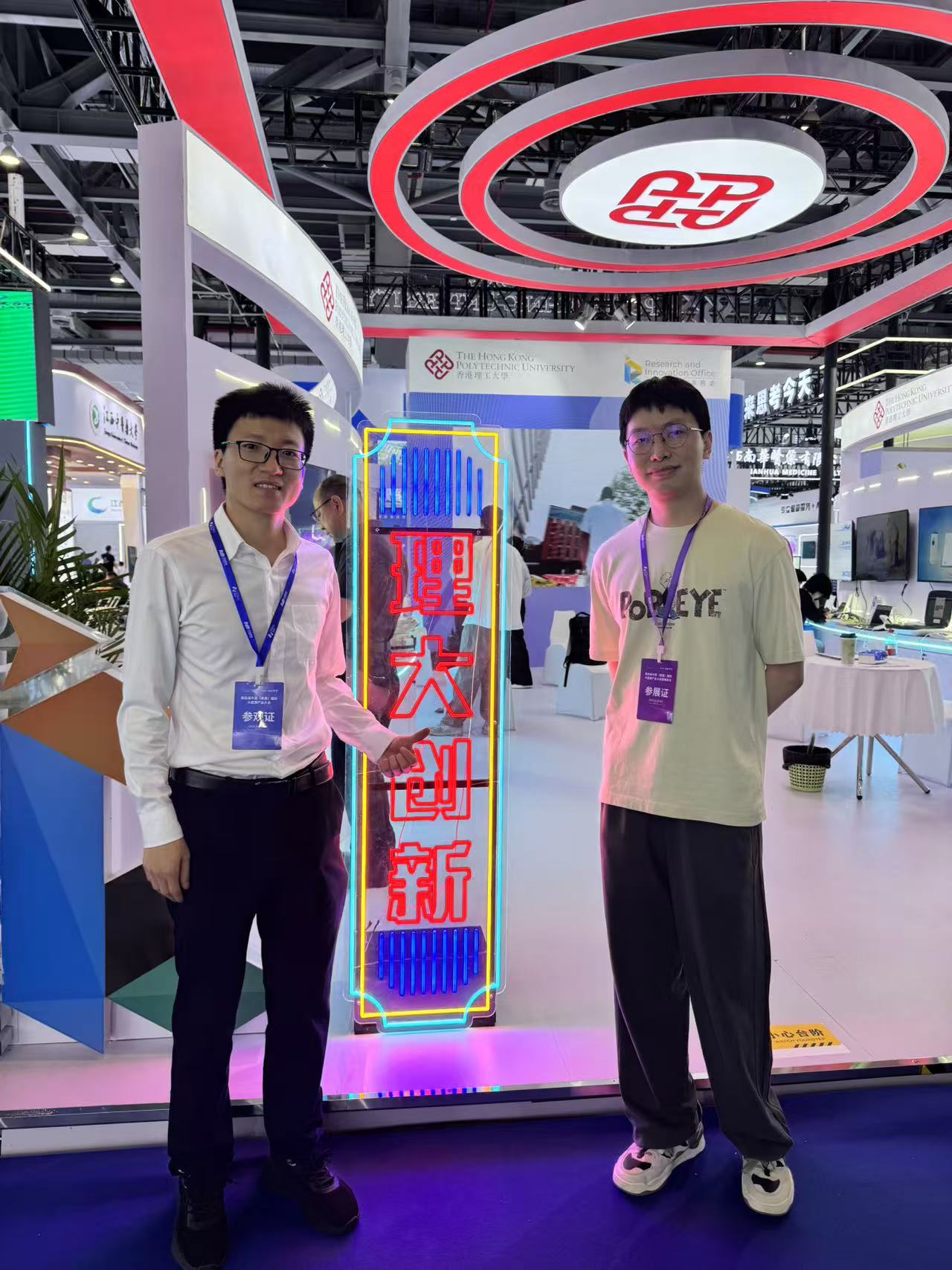
Prof. Wen and Xiangru at the Nanchang Health Expo.
Dual-feedback system
A core idea of the concept is its dual-feedback system, which uses the complementary strengths of haptic and auditory cues:
- Haptic feedback: navigation cues would be sent as intuitive vibrations through a low-latency haptic wearable device. This method is best for fast “what-to-do” commands, such as an urgent alert to dodge an obstacle, ensuring immediate physical safety with minimal cognitive load.
- Auditory feedback: auditory feedback provides the “what-is-there” and “why” context. An AI-powered voice chat can describe the environment in detail, explaining the nature and location of obstacles and other complex information.
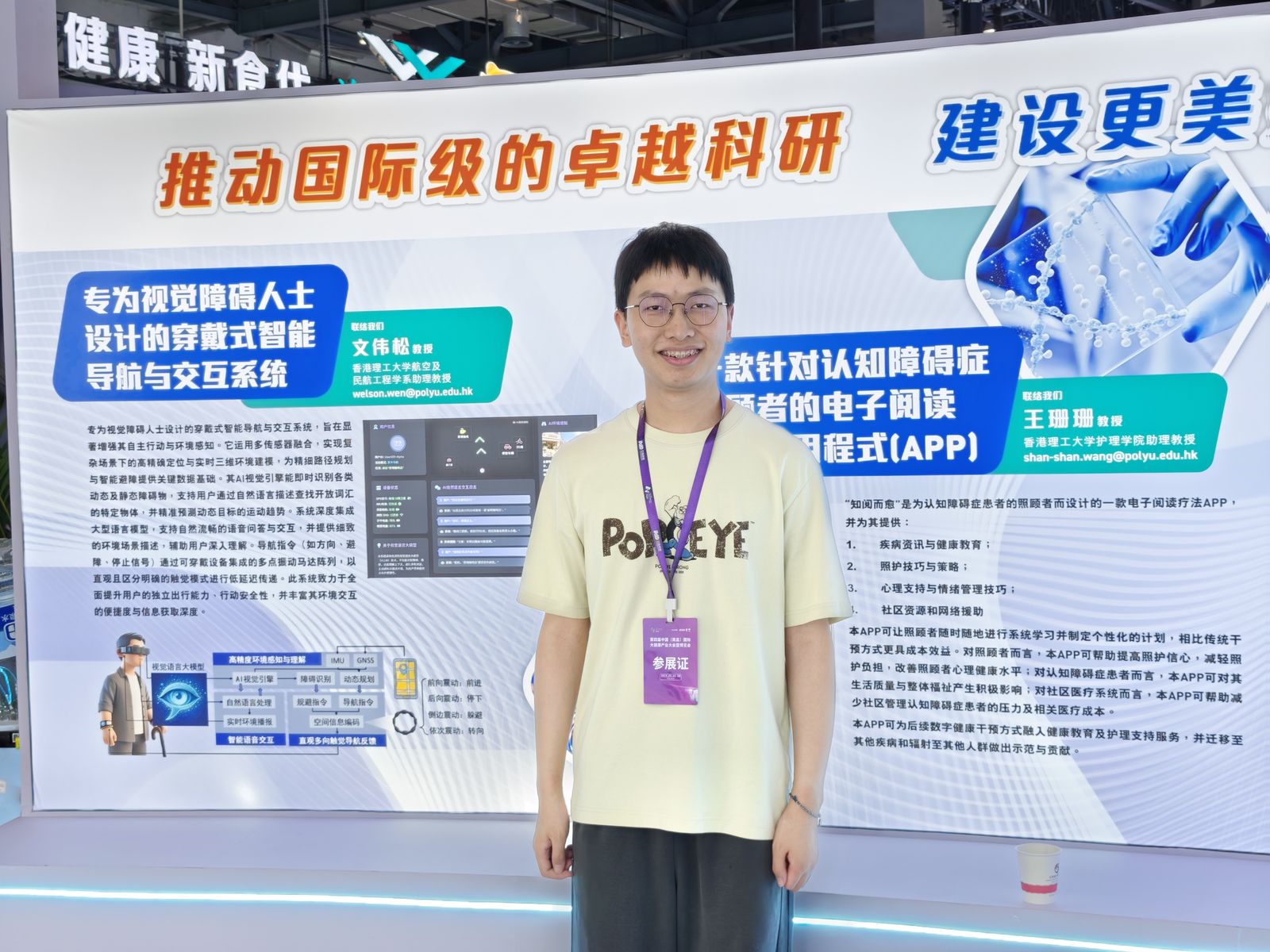
Xiangru with the project.
This combination lets users perform reflexive safety actions through touch while gaining a deeper understanding of the environment through sound, creating a safer and more comprehensive experience than either modality could provide alone.