On 24 June 2025, the Research Centre for Unmanned Autonomous Systems (RCUAS) and the Department of Aeronautical and Aviation Engineering (AAE) of The Hong Kong Polytechnic University (PolyU) hosted the 1st Research Workshop of the Research Centre for Unmanned Autonomous Systems. The full-day workshop, held on the PolyU campus and broadcast online, brought together experts, scholars and industry collaborators from Hong Kong and around the world. It covered perception and navigation, multi-robot systems, embodied intelligence, large language models and trustworthy AI, with in-depth discussions on the latest research progress, technological breakthroughs and real-world applications.
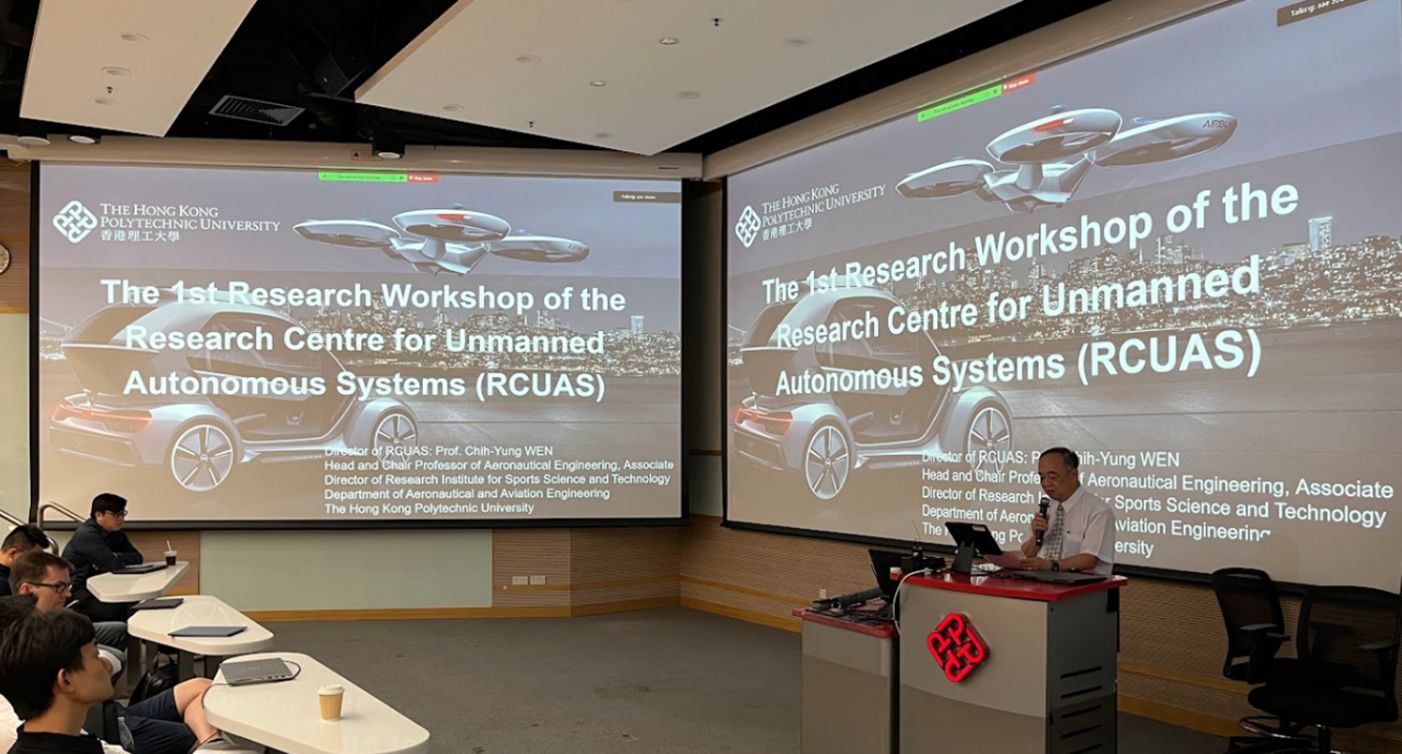
Opening remarks by Prof. Wen Chih-Yung, Director of RCUAS.
Morning session
Prof. Wen Chih-Yung, Director of RCUAS, opened the workshop by welcoming all participants. He highlighted the Centre’s mission to drive innovation in unmanned systems through interdisciplinary research and international collaboration, outlined key achievements of RCUAS, and encouraged attendees to exchange ideas to shape the future of trustworthy autonomous technologies. The morning talks were:
- Prof. Zhou Yi (Professor, School of Robotics, Hunan University (HNU)): how neuromorphic event-based vision enables safer and faster mobile robots through high-speed, low-latency perception.
- Prof. Wang Bing (Assistant Professor, AAE, PolyU): Ocean Spatial Intelligence, showcasing multi-modal underwater scene modelling and uncertainty-aware SLAM for robust marine robotics.
- Mr. Chan Yin Yuen, on behalf of Prof. Ng Kam Hung (Associate Professor, AAE, PolyU): an automated UAV-based aircraft inspection system combining 3D LiDAR SLAM and deep learning for precise defect detection.
- Prof. Huang Hailong (Assistant Professor, AAE, PolyU): advanced algorithms for fast and safe UAV flight using convexification techniques.
- Dr Li Boyang (Lecturer in Aerospace Systems Engineering, School of Engineering, University of Newcastle): integrating UAS into teaching and research in Australia, with a comparative view on engineering education relevant to aerospace applications.
The morning session concluded with mutual enthusiasm for future joint projects.
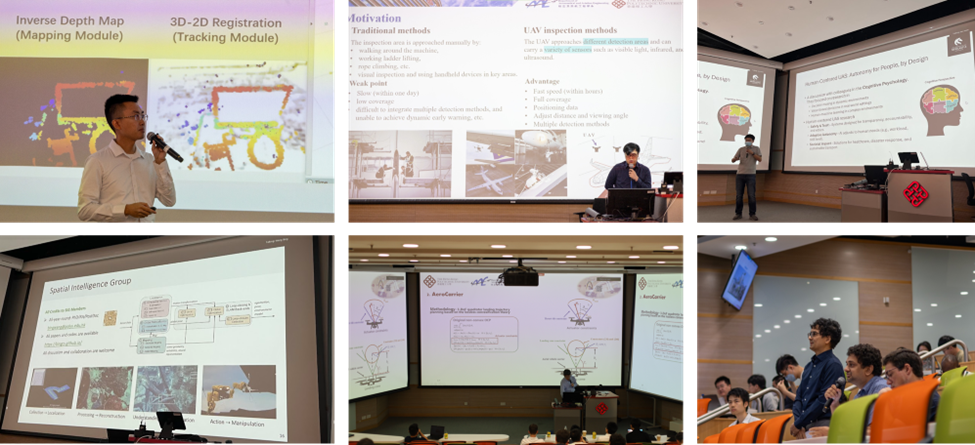
Speakers and participants share research findings, ideas and lively discussions during the RCUAS workshop at PolyU.
Afternoon session
The afternoon session continued to showcase research and international collaboration in unmanned systems:
- Dr Hu Wenbo, on behalf of Prof. Dong You (Associate Professor of Intelligent Maintenance, Department of Civil and Environmental Engineering, PolyU): an AI-assisted UAV system for bridge defect detection and digital perception, demonstrating lightweight crack segmentation and advanced point cloud processing validated through real-world deployments.
- Prof. Wang Chaoqun (Professor, School of Control Science and Engineering, Shandong University): embodied perception and navigation, highlighting how intelligent interaction with complex environments advances autonomous capabilities.
- Dr Chu Xiangyu (Research Assistant Professor, Department of Mechanical and Automation Engineering, The Chinese University of Hong Kong (CUHK)): morphological designs and motor intelligence strategies for embodied agility in autonomous systems, with applications ranging from hopping robots to transformable platforms for diverse terrain.
- Dr Tim Pfeifer (Siemens AG), after a short break: industrial indoor localisation, bridging practical deployment and academic research while exploring the potential of Bluetooth, Wi-Fi and 5G for large-scale, real-time tracking.
The workshop concluded with an open discussion on key issues in ensuring trustworthy AI and robust autonomy, drawing connections across the day’s presentations. Prof. Wen Weisong delivered the closing statement, thanking all speakers and participants for contributing to a fruitful exchange of ideas and future directions for unmanned autonomous systems.
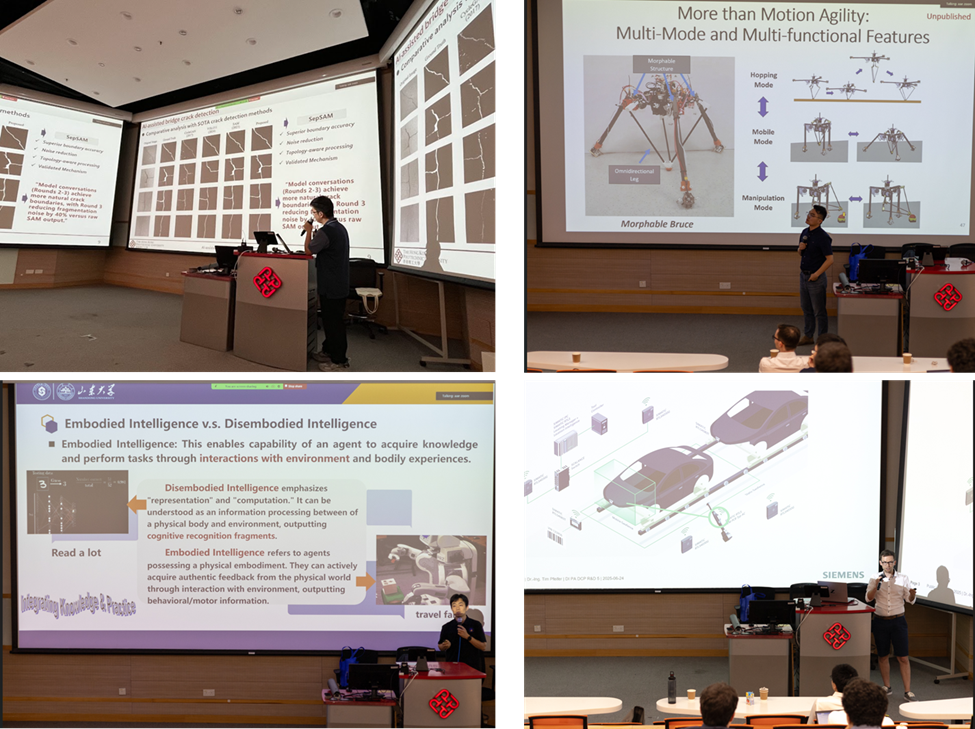
Speakers and participants share research findings, ideas and lively discussions during the RCUAS workshop at PolyU.
The First RCUAS Research Workshop fostered knowledge exchange and collaboration, bringing together experts, young scholars and industry partners to explore the future of trustworthy and innovative unmanned autonomous systems.
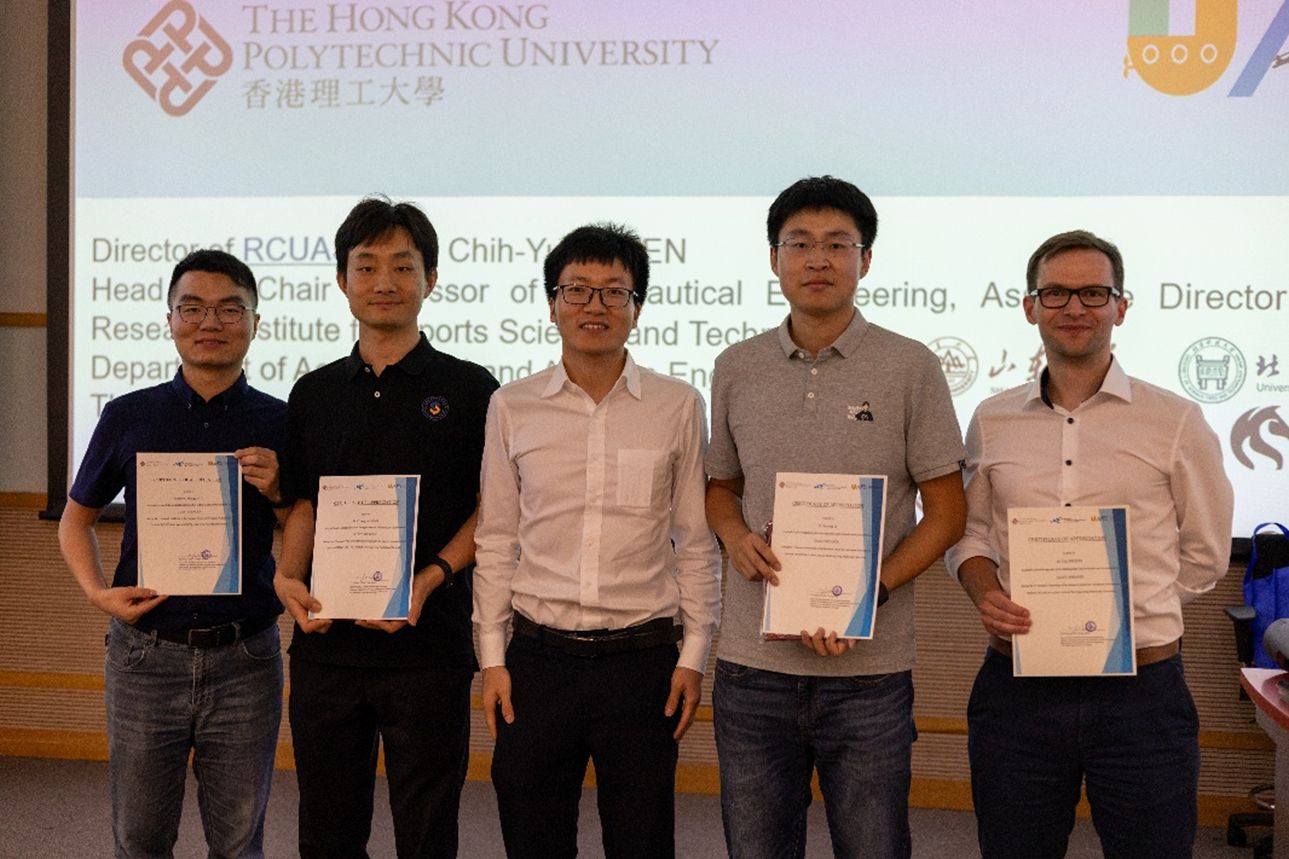
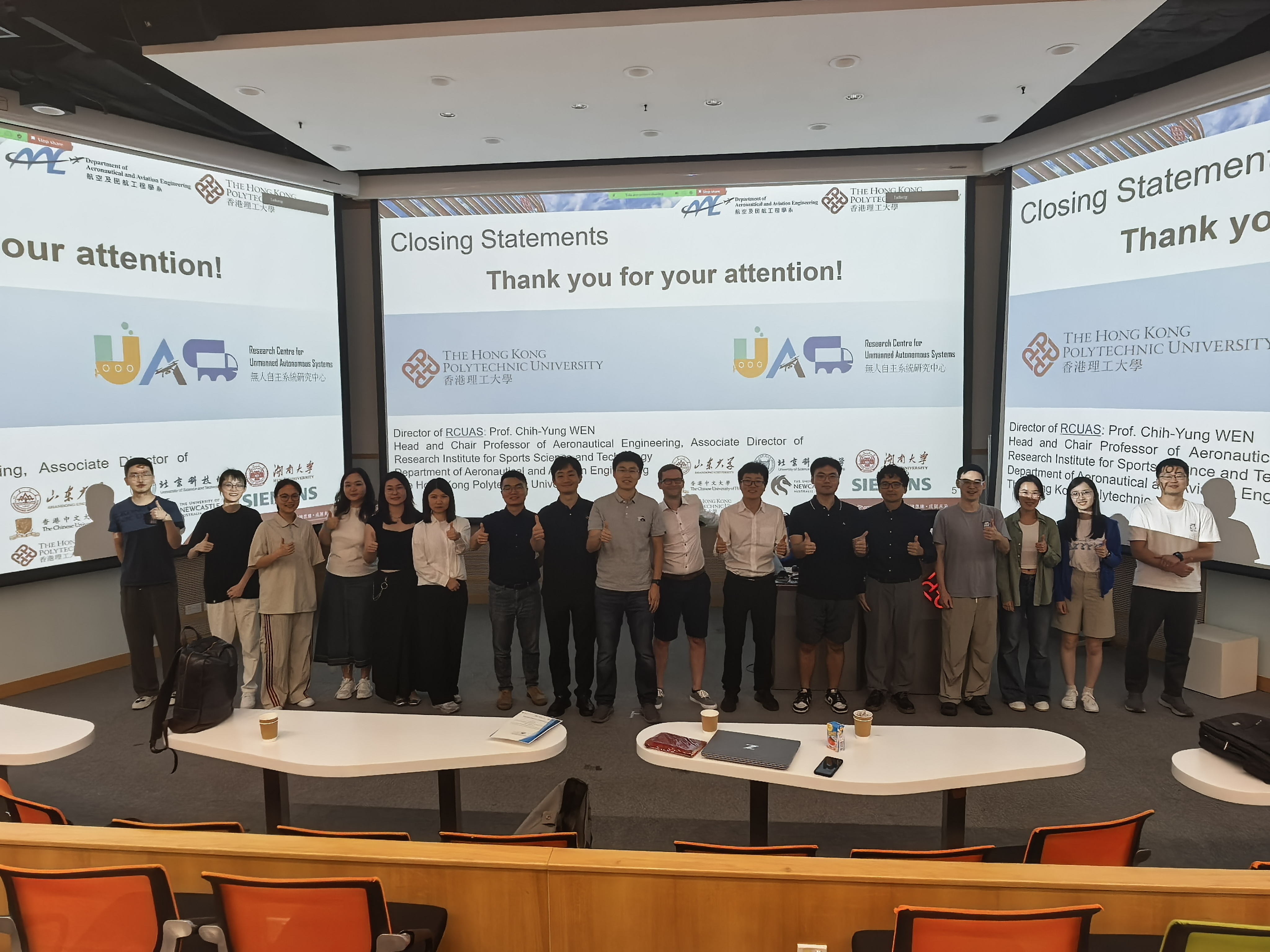
Group photos of speakers, researchers and participants at the RCUAS workshop.