On 7 May 2026, the Research Centre for Unmanned Autonomous Systems (RCUAS) at The Hong Kong Polytechnic University (PolyU) hosted its 2nd Research Workshop on the PolyU campus. The workshop brought together leading scholars, industry experts and students to explore the future of intelligent autonomous technologies.
The event showcased PolyU’s growing strength in unmanned autonomous systems and served as a platform for knowledge exchange and collaboration across academia and industry. Participants engaged in lively discussions on autonomous systems, embodied intelligence, trustworthy AI, robotics and applications to the low-altitude economy.
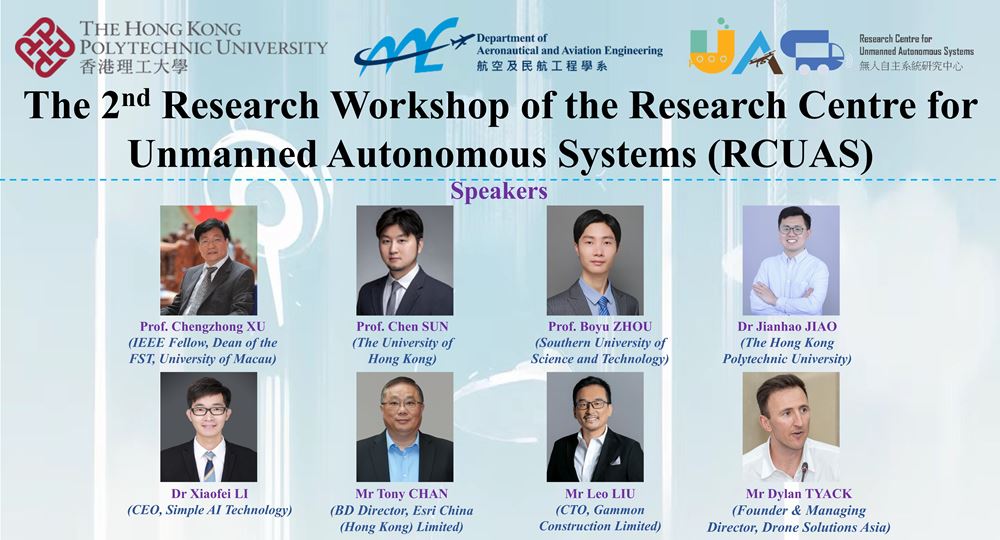
Speakers of the 2nd Research Workshop of RCUAS.
Morning session
The workshop opened with remarks by Prof. Chih-Yung Wen, Director of RCUAS and Chair Professor of Aeronautical Engineering at the Department of Aeronautical and Aviation Engineering (AAE). He highlighted the critical role of interdisciplinary collaboration in advancing research that addresses major societal and industrial needs.
The morning talks addressed research challenges in robotics and intelligent systems:
- Prof. Boyu Zhou (Southern University of Science and Technology): recent progress in efficient active perception and mobile manipulation.
- Prof. Chen Sun (The University of Hong Kong): trustworthy driving intelligence, focusing on the challenges of generalization, safety and deployment in autonomous driving systems.
- Dr Xiaofei Li (CEO, Simple AI Technology): the rapid rise of embodied intelligence and perspectives on the next stage of AI development.
- Mr Leo Liu (CTO, Gammon Construction Limited): the transformative potential of autonomous systems in the construction sector, along with the practical challenges of industry integration.
An open discussion session before lunch brought together professors and industry leaders to reflect on how academia can build distinctive research strengths amid the rapid advancement of industrial AI and autonomous technologies.
Afternoon session
The afternoon talks highlighted advances in robust autonomous driving, SLAM technologies, digital twins and drone applications:
- Prof. Chengzhong Xu (IEEE Fellow and Dean of the Faculty of Science and Technology, University of Macau): robust autonomous driving in mixed traffic environments.
- Dr Jianhao Jiao (PolyU): lifelong spatial memory and navigation for legged robots through advanced SLAM techniques.
- Mr Tony Chan (Esri China (Hong Kong) Limited): the role of GIS and living digital twin technologies in supporting the development of the low-altitude economy.
- Mr Dylan Tyack (Founder and Managing Director, Drone Solutions Asia): practical drone operations and the opportunities they present for Hong Kong’s low-altitude economy.
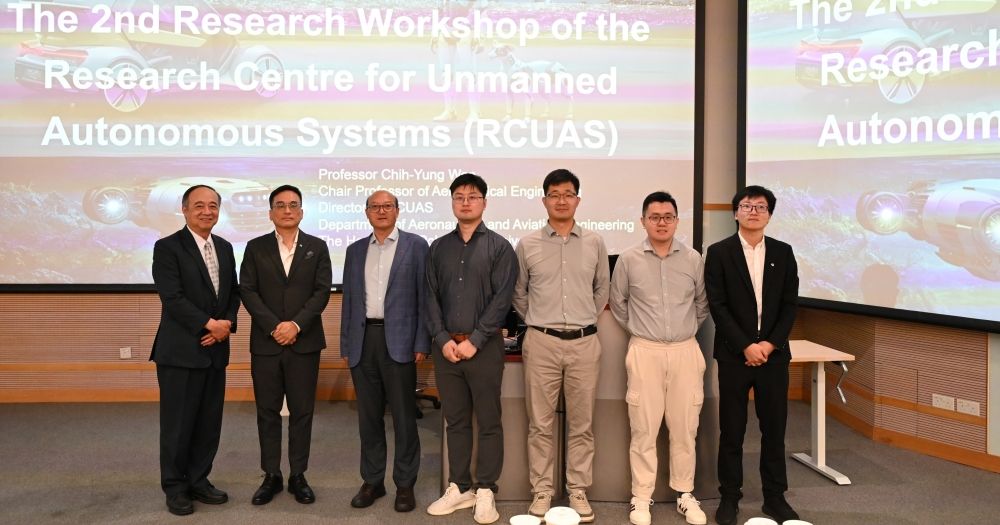
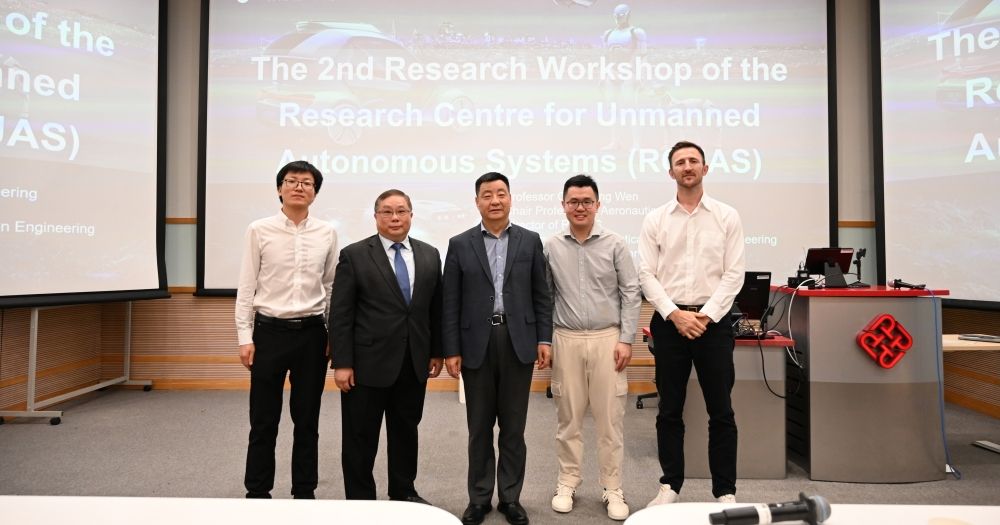
Speakers at the 2nd Research Workshop for RCUAS.
Demo and poster sessions
Beyond the presentations, the workshop featured demonstration sessions, poster presentations of RCUAS’s research outputs and interactive exchanges, giving participants opportunities to connect, share ideas and start new collaborations.
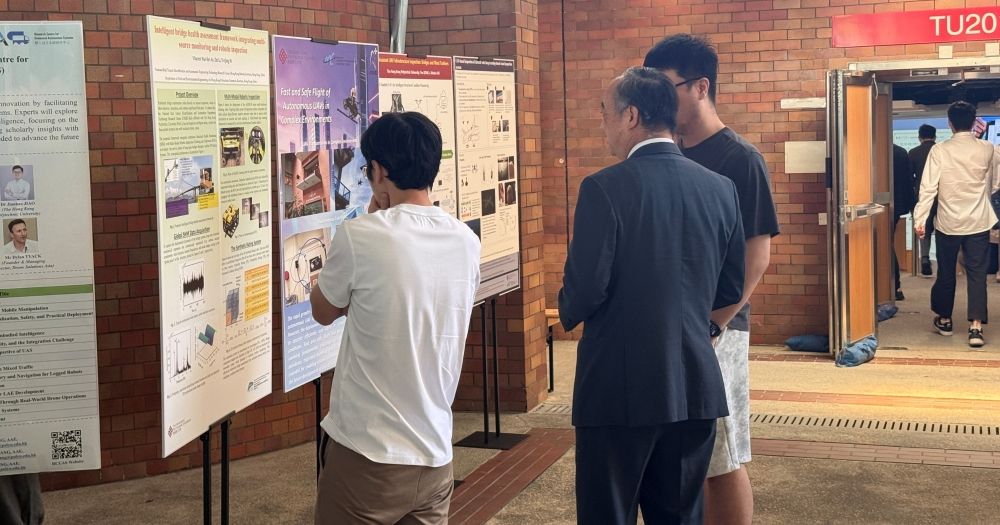

Poster session and group photo at the 2nd Research Workshop for RCUAS.
Through this event, RCUAS demonstrated its dedication to fostering interdisciplinary research and strengthening ties between universities and industry. By bridging academic research with practical application, PolyU continues to drive innovation in intelligent autonomous technologies and support their impact across transportation, robotics, urban infrastructure and aerospace engineering.
More details can be found on the PolyU RCUAS news page.