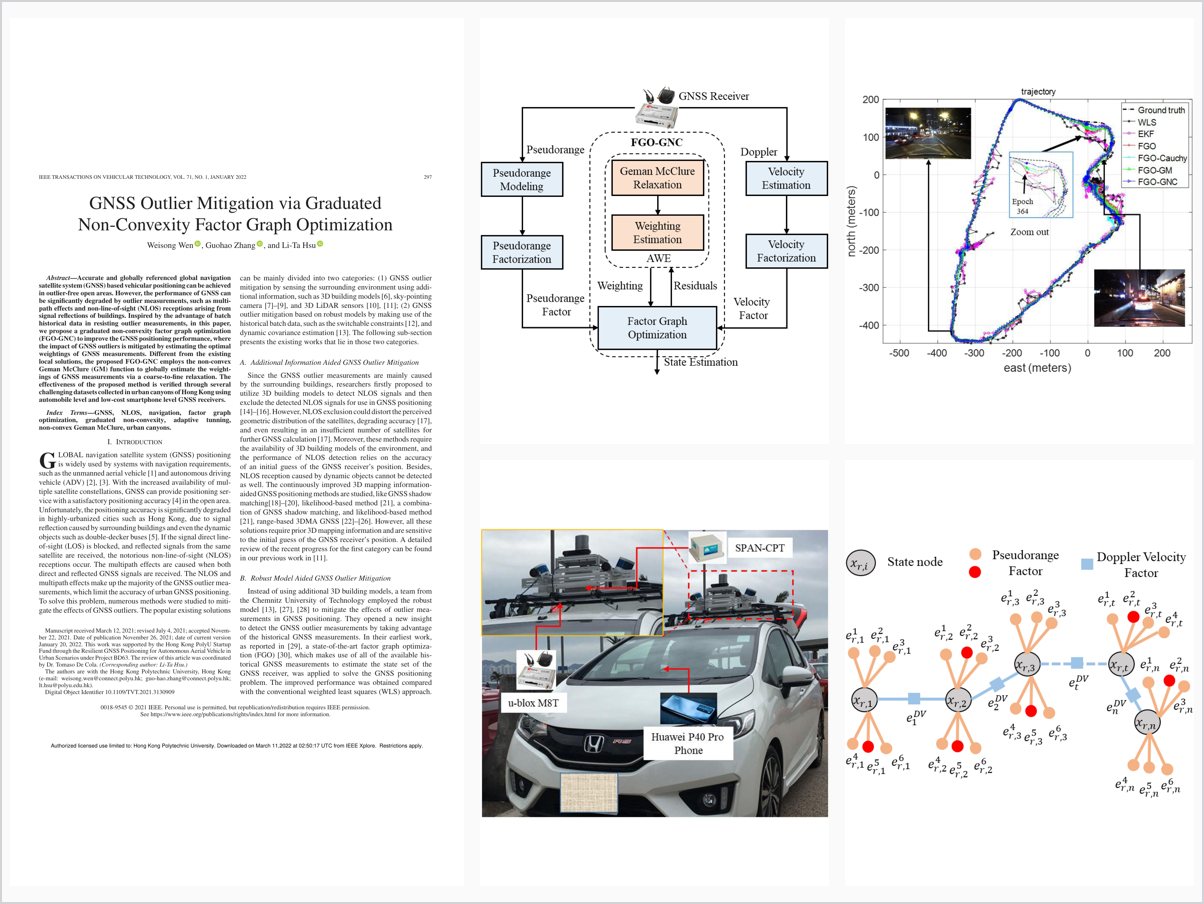
GNSS Outlier Mitigation via Graduated Non-Convexity Factor Graph Optimization
Abstract
Accurate and globally referenced global navigation satellite system (GNSS) based vehicular positioning can be achieved in outlier-free open areas. However, the performance of GNSS can be significantly degraded by outlier measurements, such as multipath effects and non-line-of-sight (NLOS) receptions arising from signal reflections of buildings. Inspired by the advantage of batch historical data in resisting outlier measurements, in this paper, we propose a graduated non-convexity factor graph optimization (FGO-GNC) to improve the GNSS positioning performance, where the impact of GNSS outliers is mitigated by estimating the optimal weightings of GNSS measurements. Different from the existing local solutions, the proposed FGO-GNC employs the non-convex Geman McClure (GM) function to globally estimate the weightings of GNSS measurements via a coarse-to-fine relaxation. The effectiveness of the proposed method is verified through several challenging datasets collected in urban canyons of Hong Kong using automobile level and low-cost smartphone level GNSS receivers.
Problem Addressed
GNSS vehicular positioning is significantly degraded in urban canyons by outlier measurements such as multipath and NLOS receptions from building reflections. Existing local robust-estimation solutions can fall into local minima when downweighting such outliers.
Key Contributions
- FGO-GNC formulation combining pseudorange/Doppler factor graph optimization with adaptive weighting estimation
- Non-convex Geman-McClure function with graduated non-convexity for global weight estimation via coarse-to-fine relaxation
- First GNC-aided FGO formulation globally estimating state and measurement weightings simultaneously
- Evaluation on Hong Kong urban-canyon datasets with automobile-level and smartphone-level receivers
Conclusions
FGO-GNC improved GNSS positioning accuracy by mitigating outlier measurements without any additional sensors, verified on several urban-canyon datasets using both ITS-level and smartphone-level receivers. With the Huawei P40 Pro, the remaining error can still reach 13.6 m due to poor smartphone measurement quality. Future work includes applying FGO-GNC to carrier-phase RTK, multi-constellation and multi-frequency measurements, and fusing the vehicle dynamic model and phone IMU.