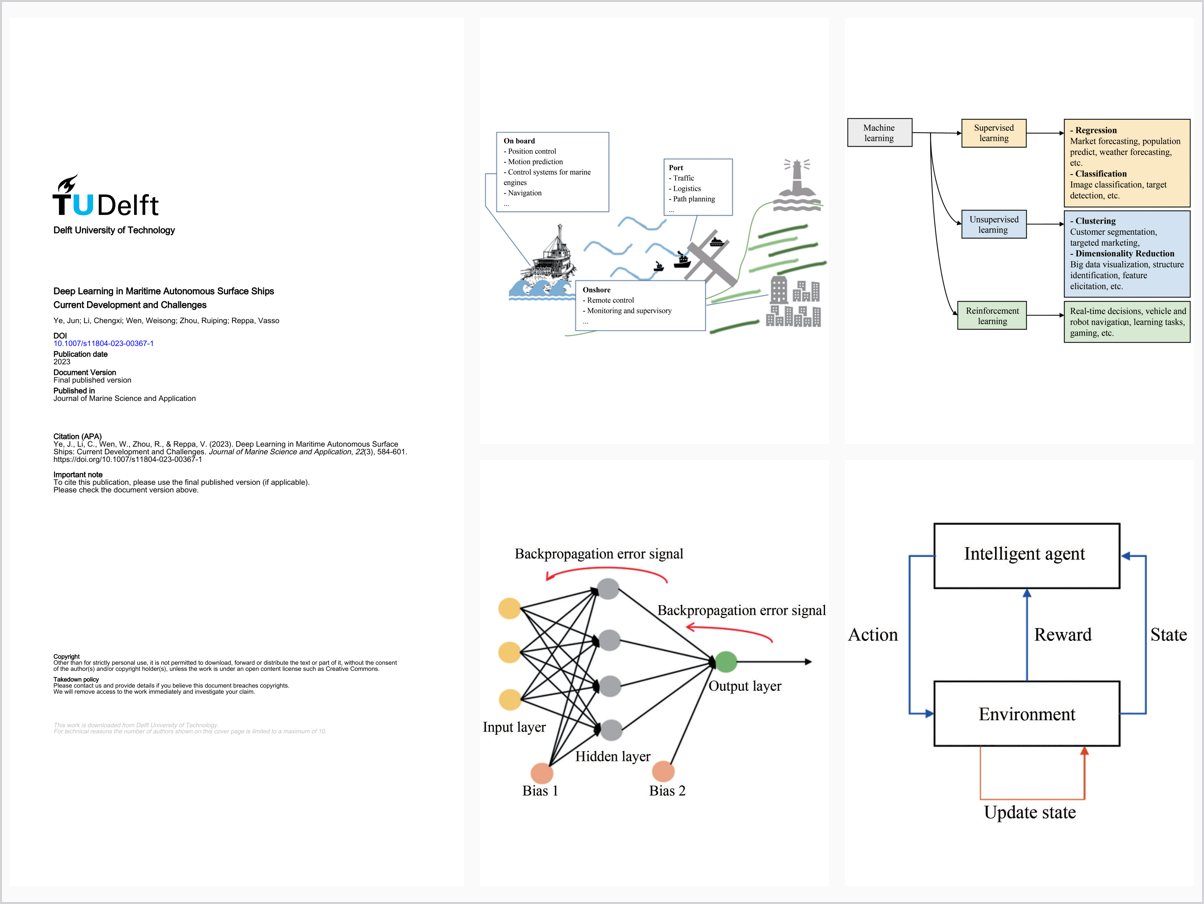
Deep Learning in Maritime Autonomous Surface Ships: Current Development and Challenges
Abstract
Autonomous surface ships have become increasingly interesting for commercial maritime sectors. Before deep learning (DL) was proposed, surface ship autonomy was mostly model-based. The development of artificial intelligence (AI) has prompted new challenges in the maritime industry. A detailed literature study and examination of DL applications in autonomous surface ships are still missing. Thus, this article reviews the current progress and applications of DL in the field of ship autonomy. The history of different DL methods and their application in autonomous surface ships is briefly outlined. Then, the previously published works studying DL methods in ship autonomy have been categorized into four groups, i.e., control systems, ship navigation, monitoring system, and transportation and logistics. The state-of-the-art of this review paper majorly lies in presenting the existing limitations and innovations of different applications. Subsequently, the current issues and challenges for DL application in autonomous surface ships are discussed. In addition, we have proposed a comparative study of traditional and DL algorithms in ship autonomy and also provided the future research scope as well. Keywords Maritime autonomous surface ships; Deep learning (DL); Artificial intelligence (AI); Review
Problem Addressed
Surface ship autonomy was mostly model-based before deep learning emerged, and a detailed literature study and examination of deep learning applications in autonomous surface ships is still missing.
Key Contributions
- Review of current progress and applications of deep learning in ship autonomy
- Brief history of deep learning methods applied to autonomous surface ships
- Categorization into control systems, ship navigation, monitoring systems, and transportation and logistics
- Comparative study of traditional and deep learning algorithms with challenges and future research scope
Conclusions
The review presents the existing limitations and innovations of deep learning applications across ship autonomy and discusses current issues and challenges. It compares traditional and deep learning algorithms for ship autonomy and outlines future research scope for maritime autonomous surface ships.