Toward Persistent Spatial Awareness: A Review of Pedestrian Dead Reckoning-Centric Indoor Positioning With Smartphones
Abstract
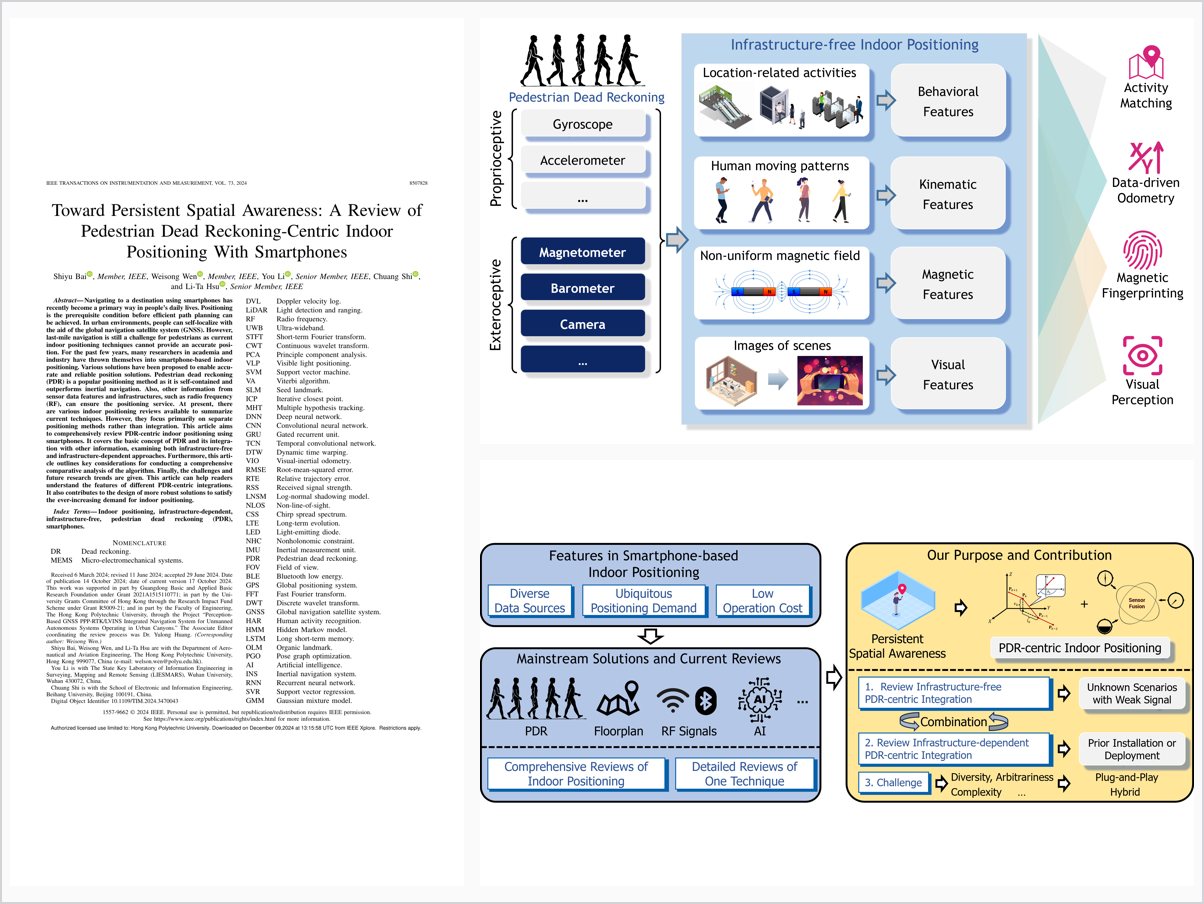
Navigating to a destination using smartphones has recently become a primary way in people’s daily lives. Positioning is the prerequisite condition before efficient path planning can be achieved. In urban environments, people can self-localize with the aid of the global navigation satellite system (GNSS). However, last-mile navigation is still a challenge for pedestrians as current indoor positioning techniques cannot provide an accurate position. For the past few years, many researchers in academia and industry have thrown themselves into smartphone-based indoor positioning. Various solutions have been proposed to enable accurate and reliable position solutions. Pedestrian dead reckoning (PDR) is a popular positioning method as it is self-contained and outperforms inertial navigation. Also, other information from sensor data features and infrastructures, such as radio frequency (RF), can ensure the positioning service. At present, there are various indoor positioning reviews available to summarize current techniques. However, they focus primarily on separate positioning methods rather than integration. This article aims to comprehensively review PDR-centric indoor positioning using smartphones. It covers the basic concept of PDR and its integration with other information, examining both infrastructure-free and infrastructure-dependent approaches. Furthermore, this article outlines key considerations for conducting a comprehensive comparative analysis of the algorithm. Finally, the challenges and future research trends are given. This article can help readers understand the features of different PDR-centric integrations. It also contributes to the design of more robust solutions to satisfy the ever-increasing demand for indoor positioning.
Problem Addressed
Last-mile indoor navigation for pedestrians remains a challenge because current indoor positioning techniques cannot provide accurate positions, and existing reviews focus on separate positioning methods rather than their integration. A comprehensive view of PDR-centric integration is missing.
Key Contributions
- Comprehensively reviews pedestrian dead reckoning centric indoor positioning using smartphones
- Covers PDR fundamentals and its integration with other information such as radio frequency signals
- Examines both infrastructure-free and infrastructure-dependent positioning approaches
- Outlines key considerations for comparative algorithm analysis plus challenges and future trends
Conclusions
The review helps readers understand the features of different PDR-centric integrations and supports the design of more robust indoor positioning solutions. It identifies challenges and future research trends to satisfy the ever-increasing demand for smartphone-based indoor positioning.