Paired Cauchy-Gaussian overbound for not symmetric unimodal heavy-tailed distributions
Abstract
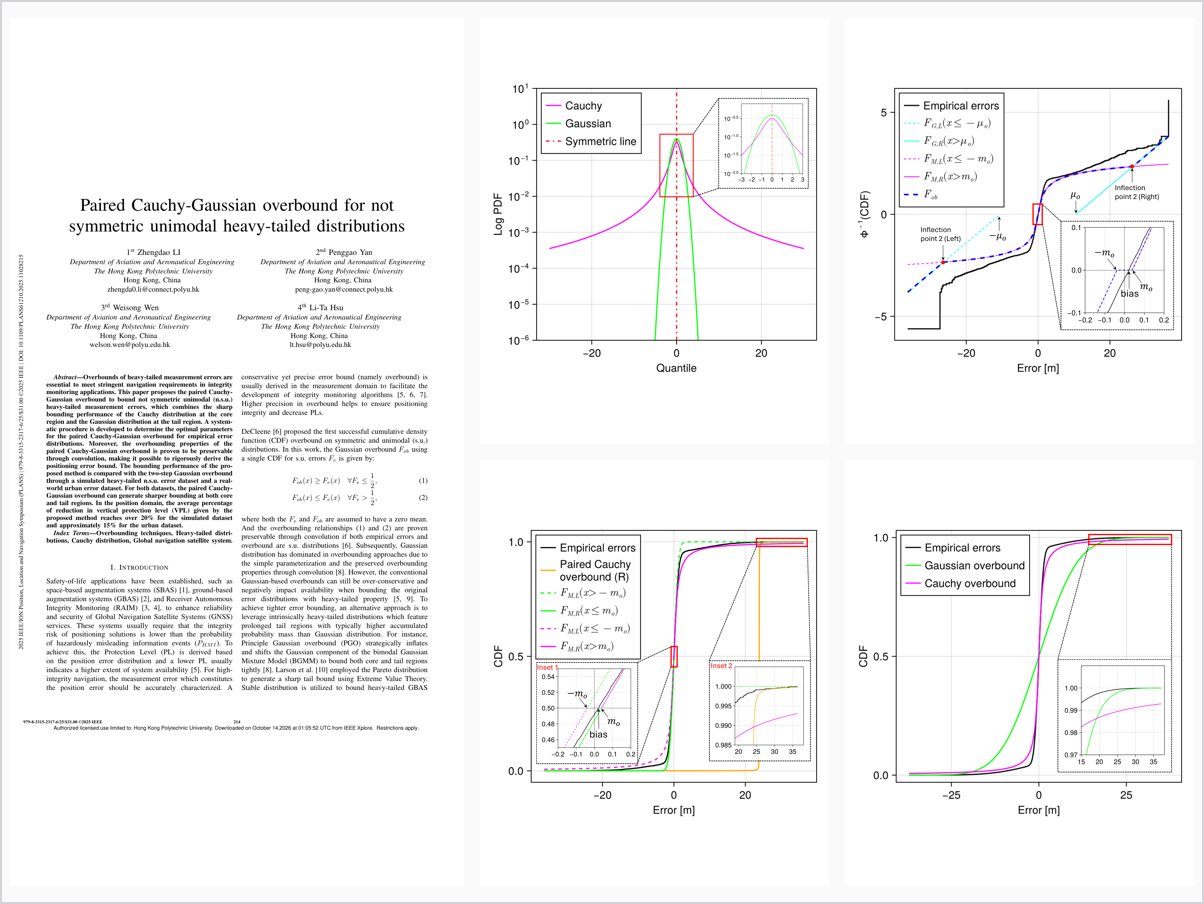
Overbounds of heavy-tailed measurement errors are essential to meet stringent navigation requirements in integrity monitoring applications. This paper proposes the paired CauchyGaussian overbound to bound not symmetric unimodal (n.s.u.) heavy-tailed measurement errors, which combines the sharp bounding performance of the Cauchy distribution at the core region and the Gaussian distribution at the tail region. A systematic procedure is developed to determine the optimal parameters for the paired Cauchy-Gaussian overbound for empirical error distributions. Moreover, the overbounding properties of the paired Cauchy-Gaussian overbound is proven to be preservable through convolution, making it possible to rigorously derive the positioning error bound. The bounding performance of the proposed method is compared with the two-step Gaussian overbound through a simulated heavy-tailed n.s.u. error dataset and a realworld urban error dataset. For both datasets, the paired CauchyGaussian overbound can generate sharper bounding at both core and tail regions. In the position domain, the average percentage of reduction in vertical protection level (VPL) given by the proposed method reaches over 20% for the simulated dataset and approximately 15% for the urban dataset.
Problem Addressed
Integrity monitoring requires overbounds of heavy-tailed measurement errors to meet stringent navigation requirements, but existing overbounding methods struggle to sharply bound not-symmetric unimodal heavy-tailed errors at both the core and tail regions.
Key Contributions
- Paired Cauchy-Gaussian overbound combining Cauchy core bounding with Gaussian tail bounding for n.s.u. errors
- Systematic three-step procedure to determine optimal overbound parameters for empirical error distributions
- Proof that the overbounding properties are preserved through convolution, enabling rigorous position error bounds
- Comparison against two-step Gaussian overbound on simulated and real-world Hong Kong urban error datasets
Conclusions
The paired Cauchy-Gaussian overbound generates sharper bounding than the two-step Gaussian overbound at both core and tail regions for both datasets. In the position domain, the average vertical protection level reduction exceeds 20% for the simulated dataset and reaches approximately 15% for the urban dataset.