Urban GNSS Positioning for Consumer Electronics: 3D Mapping and Advanced Signal Processing
Abstract
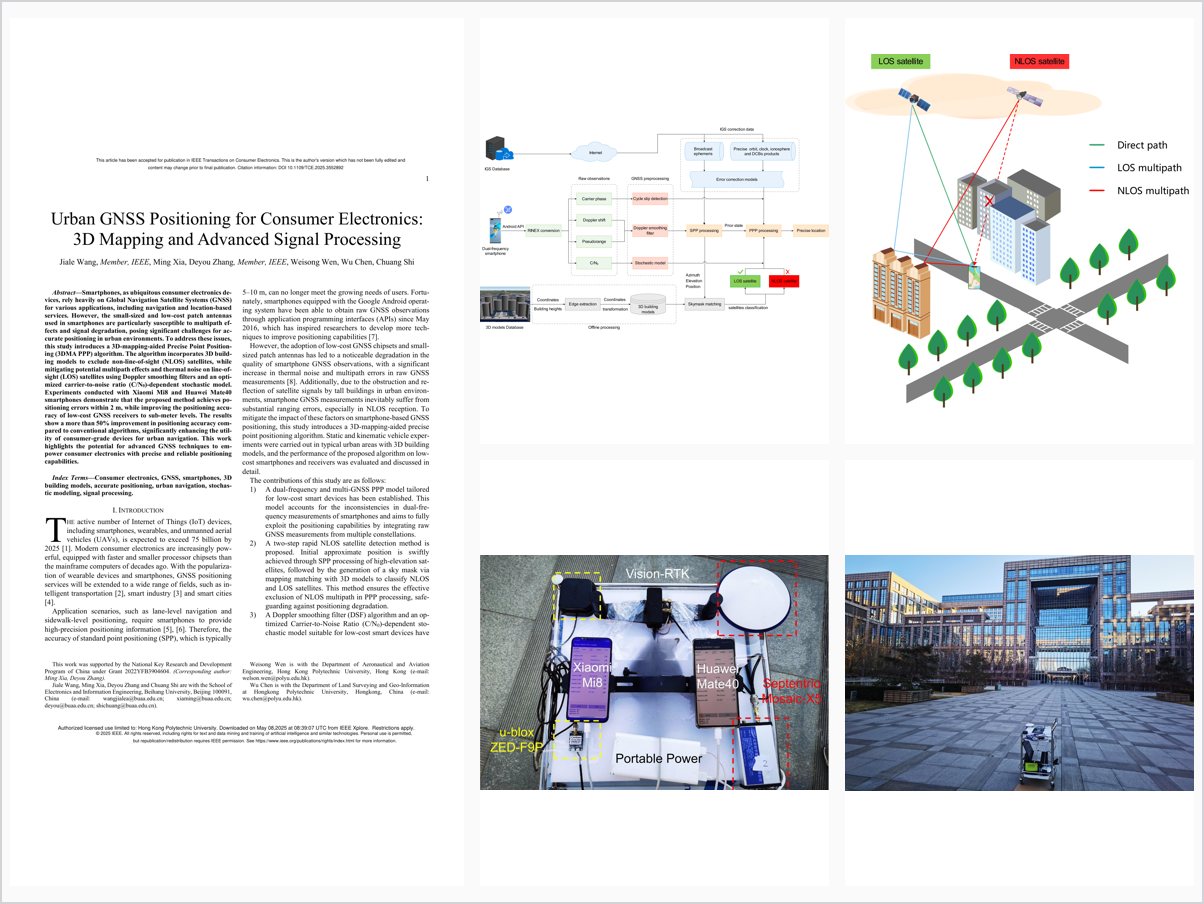
Smartphones, as ubiquitous consumer electronics de-vices, rely heavily on Global Navigation Satellite Systems (GNSS) for various applications, including navigation and location-based services. However, the small-sized and low-cost patch antennas used in smartphones are particularly susceptible to multipath effects and signal degradation, posing significant challenges for accurate positioning in urban environments. To address these issues, this study introduces a 3D-mapping-aided Precise Point Position-ing (3DMA PPP) algorithm. The algorithm incorporates 3D build-ing models to exclude non-line-of-sight (NLOS) satellites, while mitigating potential multipath effects and thermal noise on line-of-sight (LOS) satellites using Doppler smoothing filters and an optimized carrier-to-noise ratio (C/N0)-dependent stochastic model. Experiments conducted with Xiaomi Mi8 and Huawei Mate40 smartphones demonstrate that the proposed method achieves po-sitioning errors within 2 m, while improving the positioning accuracy of low-cost GNSS receivers to sub-meter levels. The results show a more than 50% improvement in positioning accuracy compared to conventional algorithms, significantly enhancing the utility of consumer-grade devices for urban navigation. This work highlights the potential for advanced GNSS techniques to em-power consumer electronics with precise and reliable positioning capabilities.
Problem Addressed
Smartphones rely on small, low-cost patch antennas that are particularly susceptible to multipath effects and signal degradation, posing significant challenges for accurate GNSS positioning in urban environments.
Key Contributions
- Dual-frequency multi-GNSS PPP model tailored for low-cost smart devices, accounting for inconsistencies in dual-frequency smartphone measurements
- Two-step rapid NLOS detection using high-elevation SPP positioning and sky masks from 3D building models
- Doppler smoothing filter considering ionospheric cumulative error, mitigating more than 70% of thermal noise and multipath error
- Optimized C/N0-dependent stochastic model reweighting LOS satellites
Conclusions
Kinematic vehicle and static urban experiments show the 3DMA PPP algorithm improves positioning performance by more than 50% over the conventional PPP algorithm. Positioning errors of Xiaomi Mi8 and Huawei Mate40 smartphones drop from more than 5 m to 1-2 m, while low-cost u-blox ZED-F9P and Septentrio Mosaic-X5 receivers achieve sub-meter accuracy. Future work will incorporate additional smartphone sensors such as accelerometers, gyroscopes, magnetometers, and barometers.