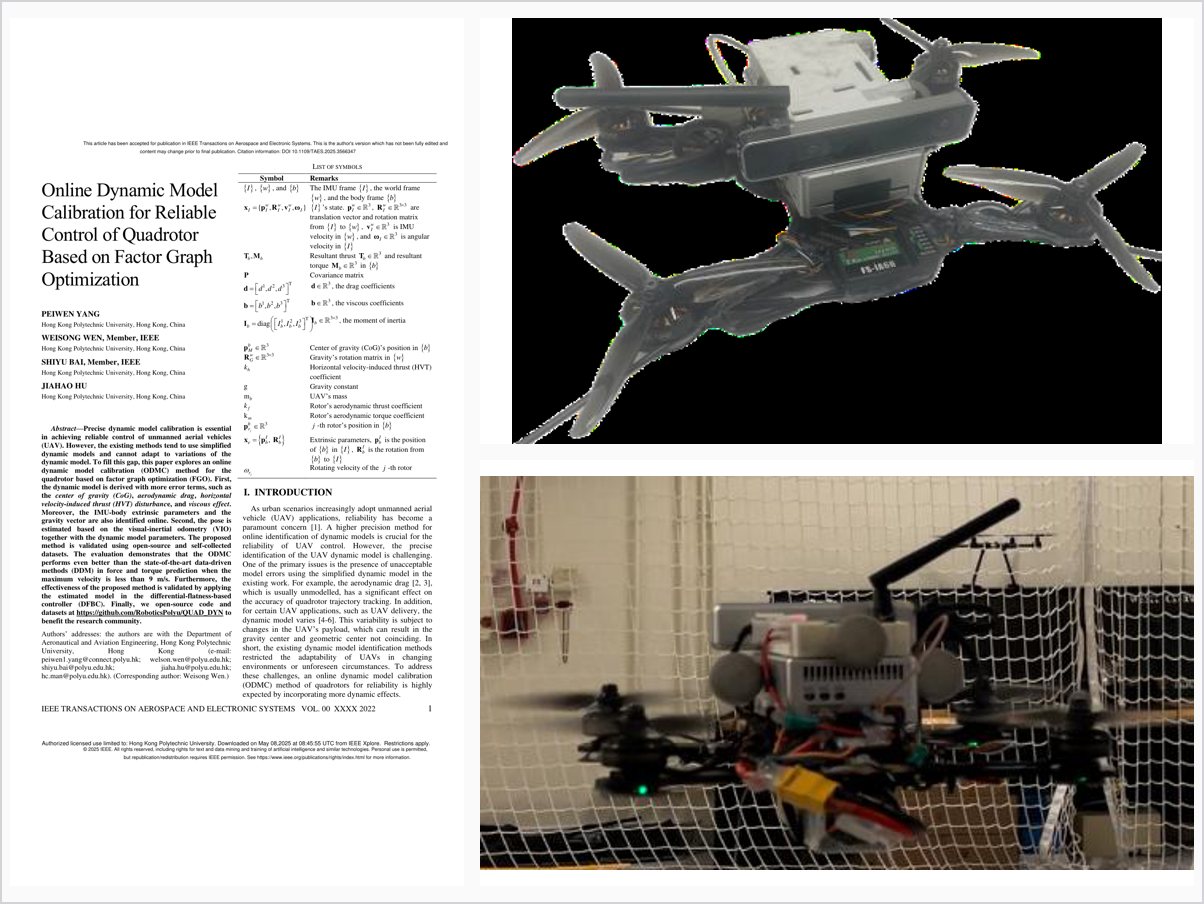
Online Dynamic Model Calibration for Reliable Control of Quadrotor Based on Factor Graph Optimization
Abstract
Precise dynamic model calibration is essential in achieving reliable control of unmanned aerial vehicles (UAV). However, the existing methods tend to use simplified dynamic models and cannot adapt to variations of the dynamic model. To fill this gap, this paper explores an online dynamic model calibration (ODMC) method for the quadrotor based on factor graph optimization (FGO). First, the dynamic model is derived with more error terms, such as the center of gravity (CoG), aerodynamic drag, horizontal velocity-induced thrust (HVT) disturbance, and viscous effect. Moreover, the IMU-body extrinsic parameters and the gravity vector are also identified online. Second, the pose is estimated based on the visual-inertial odometry (VIO) together with the dynamic model parameters. The proposed method is validated using open-source and self-collected datasets. The evaluation demonstrates that the ODMC performs even better than the state-of-the-art data-driven methods (DDM) in force and torque prediction when the maximum velocity is less than 9 m/s. Furthermore, the effectiveness of the proposed method is validated by applying the estimated model in the differential-flatness-based controller (DFBC). Finally, we open-source code and datasets athttps://github.com/RoboticsPolyu/QUAD_DYNto benefit the research community.
Problem Addressed
Reliable quadrotor control requires precise dynamic model calibration, but existing methods rely on simplified dynamic models and cannot adapt to variations in the vehicle’s dynamics.
Key Contributions
- FGO-based online dynamic model calibration jointly estimating state, IMU-body extrinsics, gravity vector, and dynamic parameters
- Enhanced dynamic model including center of gravity, aerodynamic drag, horizontal velocity-induced thrust disturbance, and viscous effects
- Actuator model mapping motor inputs to rotor velocity, extracting the aerodynamic torque coefficient to resolve joint observability with z-axis inertia
- Open-source code and datasets for calibration and control validation
Conclusions
Validation on open-source and self-collected datasets shows ODMC outperforms state-of-the-art data-driven methods in force and torque prediction when maximum velocity is below 9 m/s, and torque remains accurately predicted even after changing the center of gravity. Applied within a differential-flatness-based controller, the calibrated model improves trajectory tracking performance. Future work will extend the framework to outdoor scenarios.