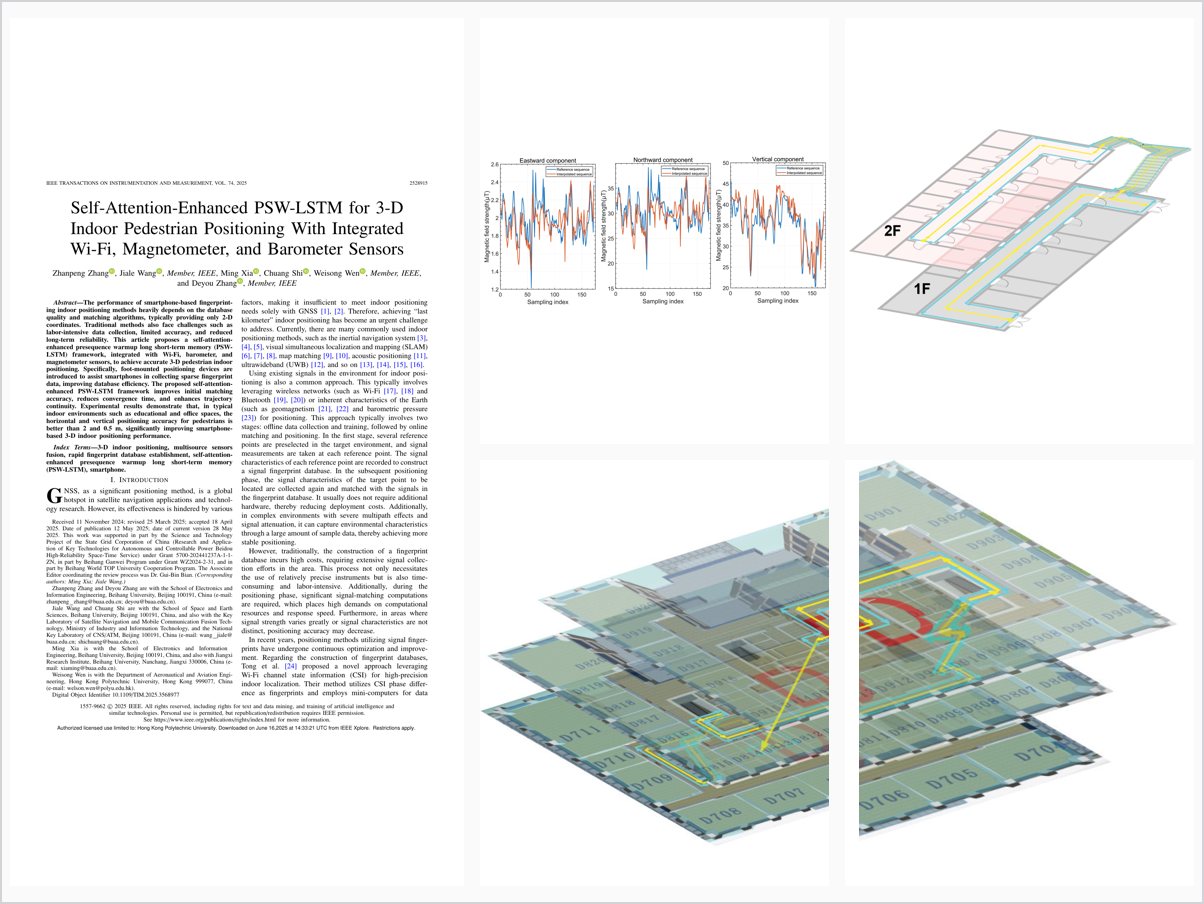
Self-Attention-Enhanced PSW-LSTM for 3-D Indoor Pedestrian Positioning With Integrated Wi-Fi, Magnetometer, and Barometer Sensors
Abstract
The performance of smartphone-based fingerprinting indoor positioning methods heavily depends on the database quality and matching algorithms, typically providing only 2D coordinates. Traditional methods also face challenges like labor-intensive data collection, limited accuracy, and reduced longterm reliability. This paper proposes a Self-Attention-Enhanced Pre-Sequence Warmup Long Short-Term Memory (PSW-LSTM) framework, integrated with WiFi, barometer, and magnetometer sensors, to achieve accurate 3D pedestrian indoor positioning. Specifically, foot-mounted positioning devices are introduced to assist smartphones in collecting sparse fingerprint data, improving database efficiency. The proposed Self-Attention-Enhanced PSW-LSTM framework improves initial matching accuracy, reduces convergence time, and enhances trajectory continuity. Experimental results demonstrate that, in typical indoor environments such as educational and office spaces, the horizontal and vertical positioning accuracy for pedestrians is better than 2 meters and 0.5 meters, significantly improving smartphone-based 3D indoor positioning performance.
Problem Addressed
Smartphone-based fingerprinting indoor positioning depends heavily on database quality and matching algorithms, typically provides only 2-D coordinates, and faces labor-intensive data collection and degraded long-term reliability.
Key Contributions
- Foot-mounted positioning devices assisting smartphones in sparse fingerprint collection for efficient database construction
- Self-attention-enhanced PSW-LSTM framework fusing Wi-Fi, barometer, and magnetometer measurements
- Improved initial matching accuracy, faster convergence, and enhanced trajectory continuity
- Public release of the signal fingerprint database and testing data
Conclusions
In typical indoor environments such as educational and office spaces, the method achieves horizontal positioning accuracy better than 2 m and vertical accuracy better than 0.5 m. The model maintains strong stability even on datasets collected months apart, significantly improving smartphone-based 3-D indoor positioning performance.