Orthogonal Ray Projection: A Tangent-Space Visual Measurement Model for Robust Visual-Inertial Odometry
Abstract
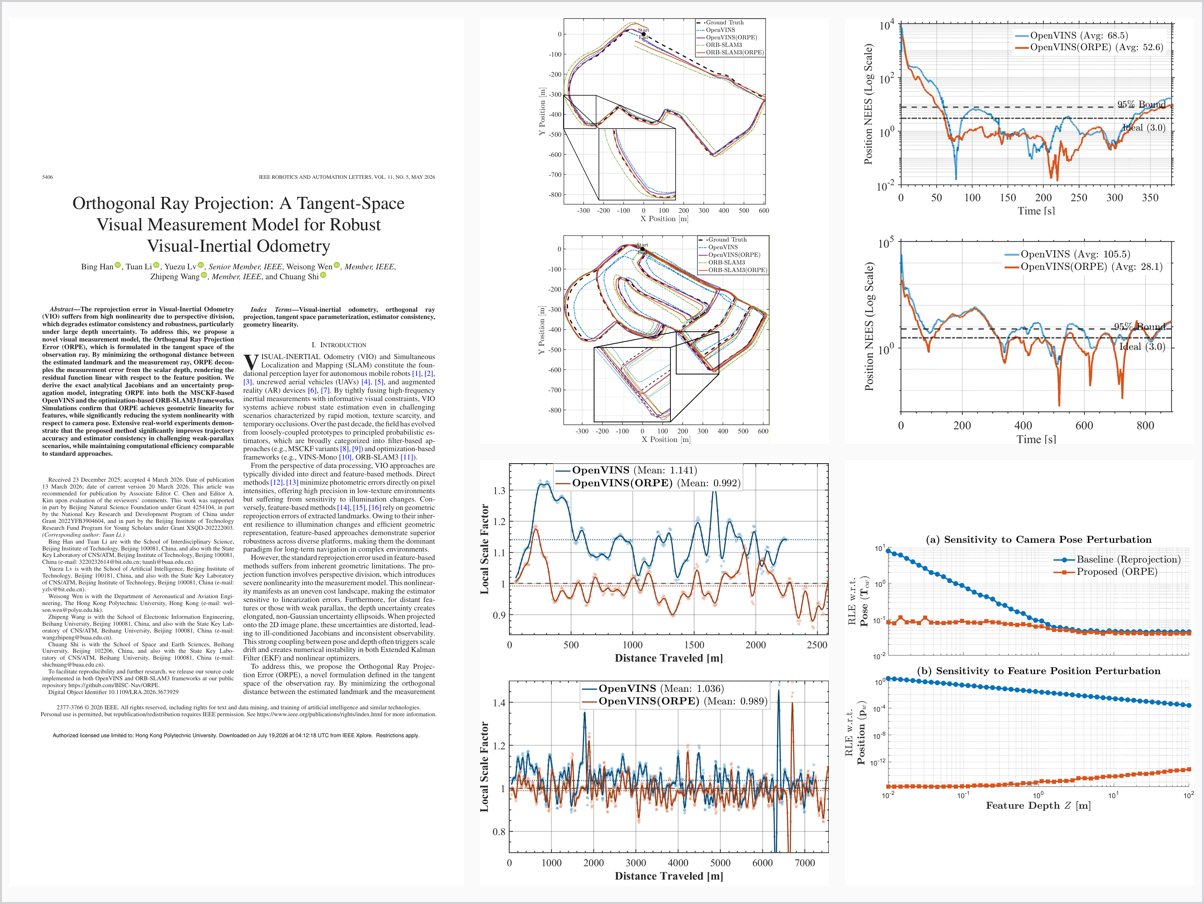
The reprojection error in Visual-Inertial Odometry (VIO) suffers from high nonlinearity due to perspective division, which degrades estimator consistency and robustness, particularly under large depth uncertainty. To address this, we propose a novel visual measurement model, the Orthogonal Ray Projection Error (ORPE), which is formulated in the tangent space of the observation ray. By minimizing the orthogonal distance between the estimated landmark and the measurement ray, ORPE decouples the measurement error from the scalar depth, rendering the residual function linear with respect to the feature position. We derive the exact analytical Jacobians and an uncertainty propagation model, integrating ORPE into both the MSCKF-based OpenVINS and the optimization-based ORB-SLAM3 frameworks. Simulations confirm that ORPE achieves geometric linearity for features, while significantly reducing the system nonlinearity with respect to camera pose. Extensive real-world experiments demonstrate that the proposed method significantly improves trajectory accuracy and estimator consistency in challenging weak-parallax scenarios, while maintaining computational efficiency comparable to standard approaches.
Problem Addressed
The reprojection error in visual-inertial odometry suffers from high nonlinearity due to perspective division, which degrades estimator consistency and robustness, particularly under large depth uncertainty.
Key Contributions
- Orthogonal Ray Projection Error (ORPE) model formulated in the tangent space of the observation ray, eliminating perspective division
- Residual linear in feature position, decoupling measurement error from scalar depth and naturally handling infinite depth
- Exact analytical Jacobians and uncertainty propagation from pixel noise to tangent space covariance
- Integration into MSCKF-based OpenVINS and optimization-based ORB-SLAM3 with open-source release
Conclusions
Simulations confirm ORPE achieves geometric linearity for features while significantly reducing system nonlinearity with respect to camera pose. Extensive real-world experiments show significantly improved trajectory accuracy and estimator consistency in challenging weak-parallax scenarios, with computational efficiency comparable to standard approaches. As a geometric model, its robustness remains constrained by feature tracking quality in dynamic or low-texture scenes.