TASLAB Students Win Championship at Hong Kong's Inaugural Physical AI Hackathon OneRobotics Track
TASLAB Students Win Championship at Hong Kong’s Inaugural Physical AI Hackathon OneRobotics Track
Four PhD students from the Trustworthy AI and Autonomous Systems Laboratory (TASLAB) at The Hong Kong Polytechnic University (PolyU) - XU Ruijie, Feng Yu, Xiao Naigui, and Wang Xin - won the championship of the OneRobotics “Third Hand” Track at Hong Kong’s inaugural Physical AI Hackathon. The 48-hour competition culminated on August 5, 2026, at the Charles K. Kao Auditorium in Hong Kong Science Park.
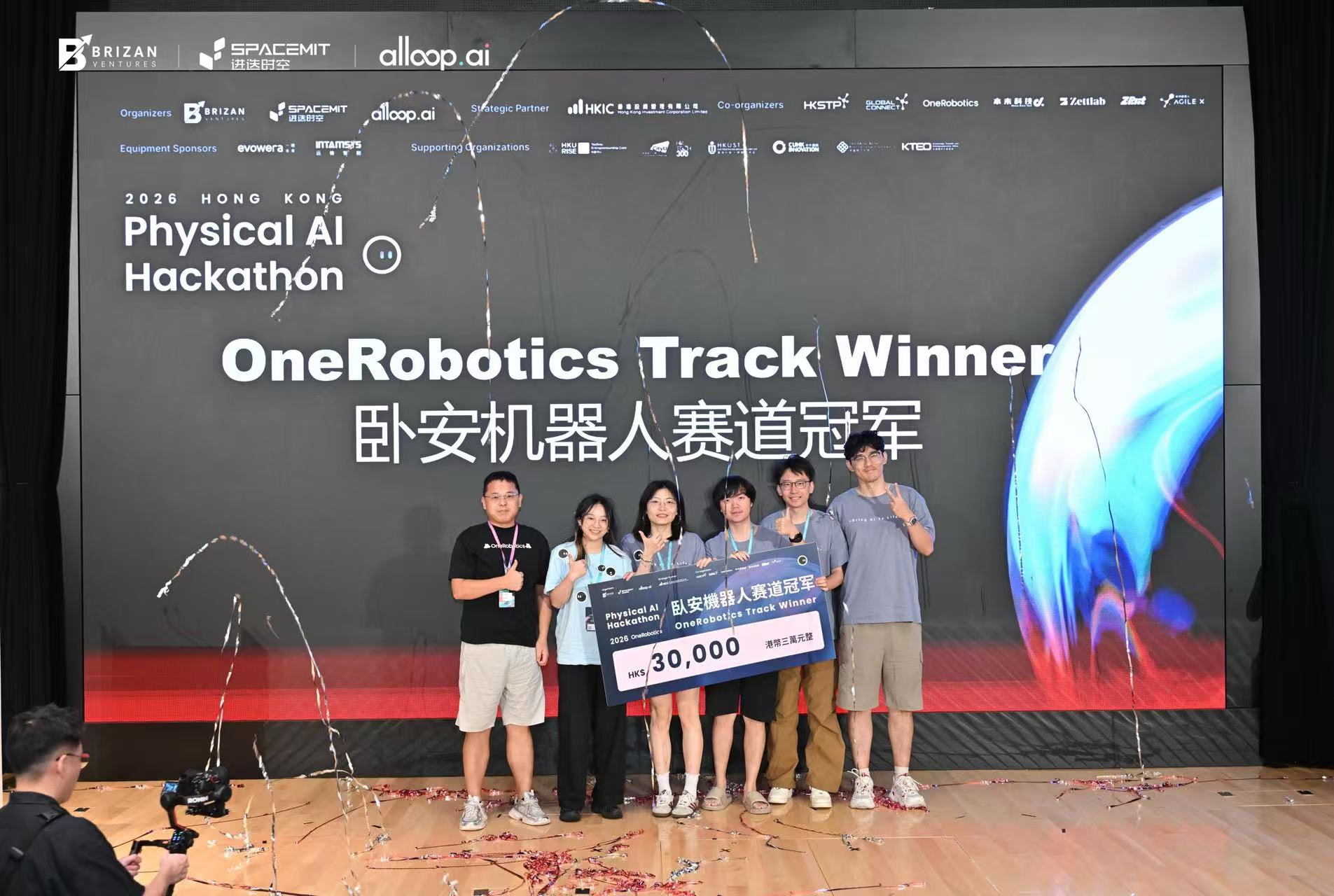
TASLAB members and fellow participants celebrate winning the OneRobotics Track championship.
During the hackathon, the team developed ARGUS, an embodied AI portrait photography system designed to serve as an autonomous “third hand” for group photography. The project addresses a familiar problem: when friends or family members want to take a group photo, someone is often left behind the camera, while conventional selfies restrict framing, distance, and posing. ARGUS turns a camera-equipped robotic arm into an AI photographer that can perceive its subjects, search for suitable viewpoints, provide real-time direction, and select the best final portraits.
Users begin a photography session simply by waving at the camera. MMPose-based perception detects the gesture, tracks participating subjects, and establishes a stable composition target. The robotic arm then explores a safety-constrained set of viewpoints and uses visual feedback to refine the framing. A Qwen3.5-Omni real-time model provides concise voice guidance, such as asking a subject to move slightly or adjust an expression. When pose, eye state, sharpness, exposure, and framing meet the required conditions, the system activates the shutter. It subsequently evaluates the candidate images for visual quality and viewpoint diversity and presents a final Top 3 selection.
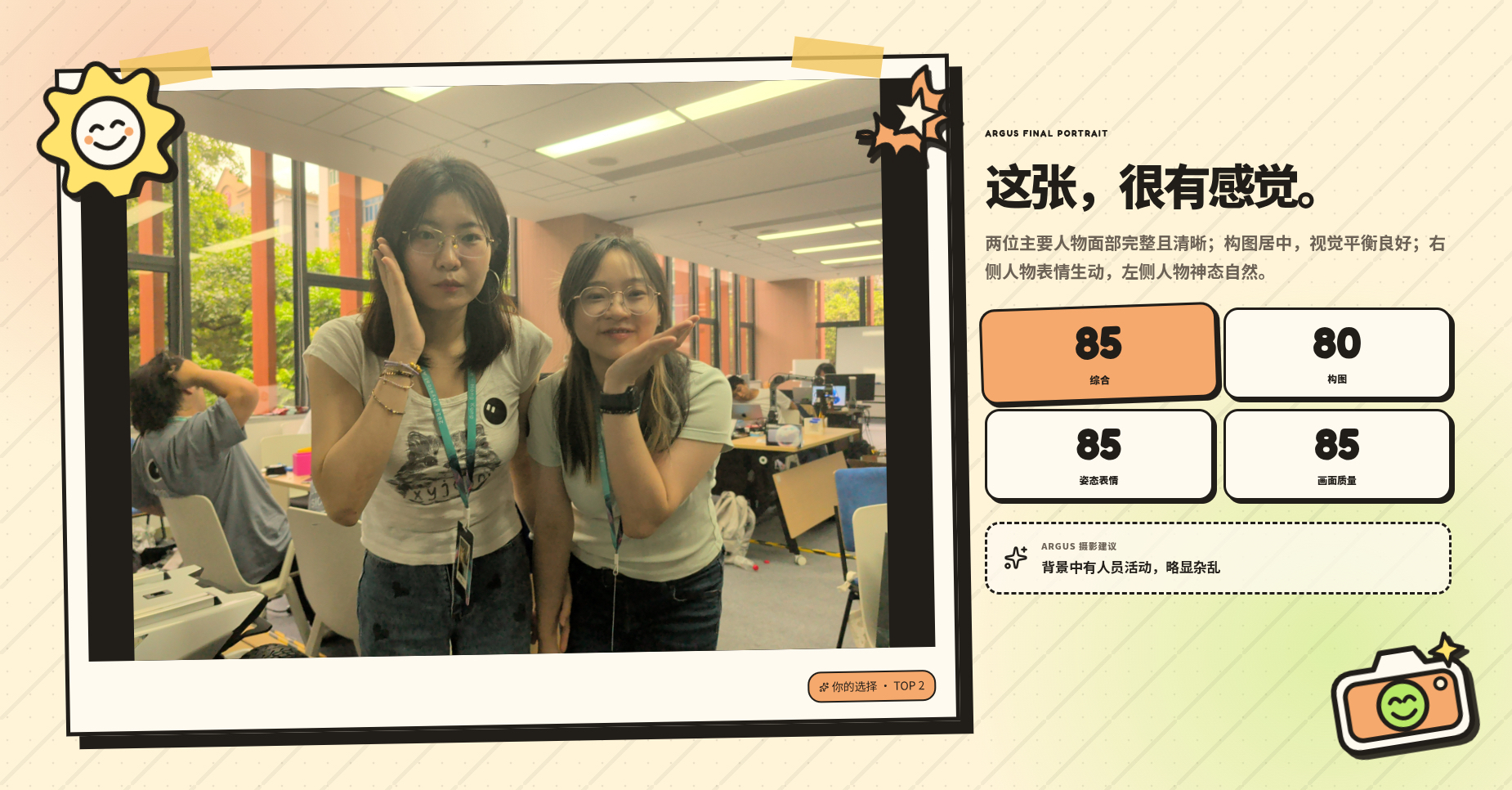
An example portrait selected and evaluated by ARGUS based on composition, expression, and image quality.
Watch the 58-second ARGUS real-world demonstration.
Rather than allowing a large model to generate robot joint commands directly, the team separated semantic decision-making, geometric control, and hardware safety. The AI director selects only from executable photography actions supplied by the system, while image-based visual servoing, MoveIt, and predefined trajectories manage physical motion within constrained operating conditions. The system observes the scene again after each movement, creating a closed loop from perception and composition to guidance, capture, and final image curation. This layered architecture enabled the team to turn its concept into a working physical prototype within 48 hours.
The hackathon was initiated by Brizan Ventures together with portfolio companies including SpacemiT and alloop.ai. Following 45 days of global recruitment, seven Meet-Ups, more than 1,000 registrations, and over 300 interviews, the event brought together more than 150 participants in over 40 teams from Hong Kong, the Greater Bay Area, and overseas universities. Twelve teams advanced to the final competition for the overall MVP award, with projects assessed on technical innovation, product value, implementation potential, and team performance. The accompanying Physical AI Carnival also connected participating teams with technology companies, investors, researchers, and members of the public.
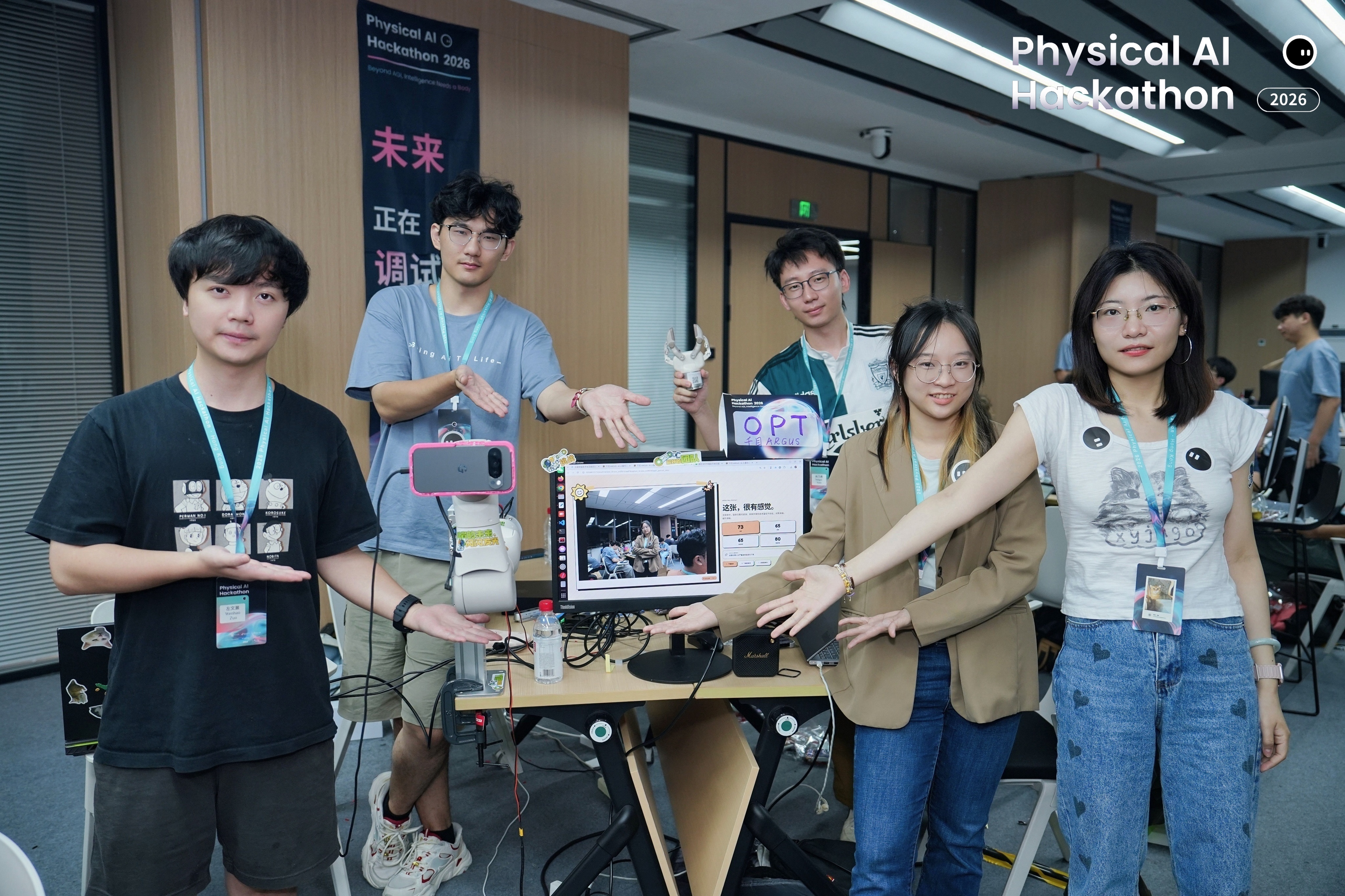
The ARGUS team demonstrates its robotic portrait photography system at the Physical AI Hackathon.
The team’s achievement demonstrates how advances in multimodal AI, visual perception, robot control, and human-robot interaction can be integrated into a system that acts in the physical world. It also reflects TASLAB’s continuing exploration of trustworthy AI and autonomous systems, with an emphasis on connecting intelligent decision-making to safe, observable, and practically meaningful physical actions.
The ARGUS source code is publicly available on GitHub.